
IPS
IPS stands for In-Plane Switching.
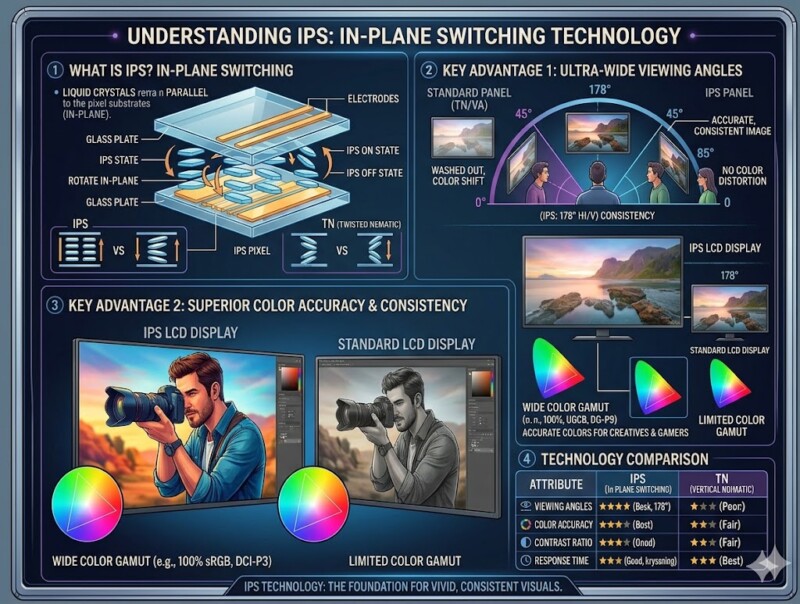
IPS is a TFT LCD technology in which the liquid crystal molecules are aligned horizontally (in-plane) between two glass substrates, rather than twisting perpendicular to the panel as in TN (Twisted Nematic) displays. This horizontal alignment is controlled by electrodes on a single substrate, allowing the crystals to rotate within the plane when voltage is applied rather than tilting toward the viewer.
The in-plane orientation produces significantly wider viewing angles than TN panels — typically 178°(H) / 178°(V) — with minimal color shift or contrast degradation when viewed off-axis. This makes IPS well-suited for applications where the display must be readable from multiple positions or by multiple viewers simultaneously. Color accuracy and consistency are also notably better than TN, making IPS a common choice for color-critical applications.
Compared to VA (Vertical Alignment) panels, IPS displays generally offer superior color accuracy and better off-axis performance, but VA panels typically achieve higher contrast ratios (deeper blacks) and lower power consumption. IPS panels have historically had slower pixel response times than TN displays, though this gap has narrowed considerably in modern panels. IPS panels can also exhibit a characteristic “IPS glow” — a faint luminance visible in dark content when viewed at an angle — which is a known limitation of the technology.
IPS is a common choice for industrial HMIs, medical instrumentation, portable test equipment, and any embedded application where viewing angle consistency and color fidelity outweigh the need for maximum contrast or the fastest possible pixel response.
Check out our complete line-up of IPS TFT LCDs for your next project.