STN
STN stands for Super-Twisted Nematic.
In a standard TN (Twisted Nematic) LCD, the liquid crystal molecules twist 90 degrees between the two glass plates. In an STN display, they twist much further, typically 180 to 270 degrees (around 240 degrees is common). That greater twist gives a much steeper voltage-to-transmission curve, so each pixel switches more sharply between on and off. That sharper threshold is the key benefit: it allows a higher multiplex ratio, meaning the display can drive many more rows in a passive matrix while keeping usable contrast and viewing angle. This is why STN became the standard for higher-resolution character and graphic LCD modules, where TN would wash out.
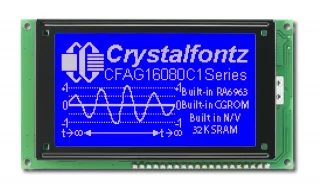
The tradeoff is that the extreme twist introduces birefringence, which tints the display. That’s where the familiar STN color modes come from: yellow-green, blue (white or light pixels on a blue background), and gray. Two common variants address this:
FSTN (Film-compensated STN) adds a retardation film to cancel the color shift, producing a near-neutral black-on-white or white-on-black appearance with better contrast.
DSTN (Double STN) uses a second STN cell for compensation instead of a film. It was common in older laptops but has largely been replaced by FSTN.
Compared to TFT (active matrix), STN has slower response times, lower contrast, and narrower viewing angles, but it costs less, uses very little power, and reads well in sunlight in reflective or transflective configurations. That makes it a good fit for industrial instruments, meters, and other devices that show mostly static information.