
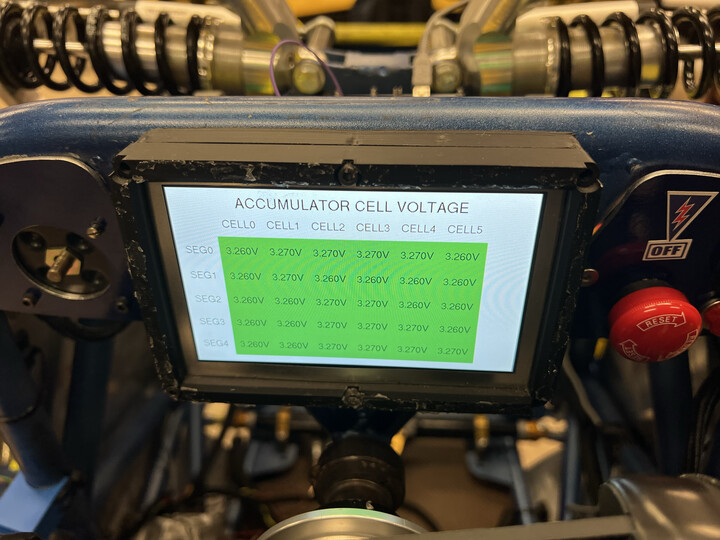
Streamlining Your Digital Dash: How the Bridgetek EVE Controller Empowers STM32 Designs

For many engineers, the leap from basic character displays to a full-color Graphical User
Interface (GUI) feels like a daunting hardware hurdle. When the FS-3 Formula SAE team began designing their 2025 car, they hit a common roadblock:
How to drive a high-resolution 5” display without overhauling their existing STM32-based architecture.
The solution wasn’t just in the pixels—it was in the silicon. By choosing the CFA800480E3-050SN, they utilized the integrated Bridgetek (EVE) display controller.
The Problem: The “Resource Hog” Reality
Standard “dumb” displays require the host microcontroller (MCU) to handle every pixel
calculation, frame buffering, and refresh cycle. For an STM32 already busy managing vehicle
telemetry and sensor data, adding a GUI can lead to:
- High CPU Overhead: Throttling your main application.
- Complex Routing: Needing high-pin-count interfaces like RGB or LVDS.
- Design Bloat: Requiring external RAM or dedicated graphics accelerators.
The Solution: Offloading the Heavy Lifting
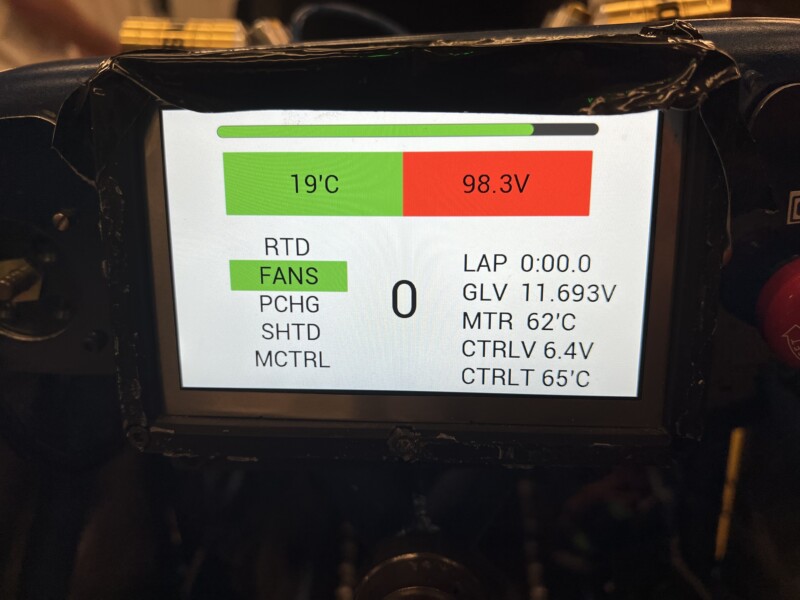
The Bridgetek Embedded Video Engine (EVE) technology changes the architecture. Instead of
the STM32 sending a massive raw bitmap over a complex bus, it sends high-level object
commands (like “Draw Button” or “Rotate Image”) over a simple SPI or QSPI interface.
Why the FS-3 Team Found This Crucial:
- Code Consistency: They used the same STM32 models found elsewhere in the car,
maintaining software library consistency. - Hardware Simplicity: No need to incorporate a separate, discrete display driver into
their custom PCB. The Bridgetek chip is already on the display module. - Sunlight Visibility: Offloading the processing didn’t mean sacrificing visual quality. The
5″ display maintained high brightness and vibrant color depth, essential for open-
cockpit racing.
From Zero Experience to Competition-Ready
The FS-3 team had never designed a digital dash before. By leveraging our public
documentation and specialized support for the Bridgetek chipset, they bypassed the “trial and
error” phase of driver development.
“The support team was a lifesaver… getting our driver code working once we had the screen.
The information our drivers needed was always sharp and readable, even in direct summer sun.”
Conclusion
You don’t need to be a graphics expert to build a professional-grade interface. By pairing the
ubiquitous STM32 with a Crystalfontz Bridgetek-enabled module, you can keep your hardware
lean and your development timeline fast.

Jeffrey Nystrom is an engineering technician at Crystalfontz. He graduated from ITT Technical Institute of Technology with his B.S. in Electronics Engineering. In his position, Jeff engages in customer technical support, works on engineering projects, and supports Crystalfontz’s manufacturing operations. Outside of the office, Jeff enjoys working in his shop, tinkering with his 3D printer, and going on new adventures with his family.