
5 Key Engineering Advantages of OLEDs

OLED (Organic Light-Emitting Diode) technology represents a significant leap from traditional LCDs because it utilizes organic compounds that emit light directly when an electric current is applied. Unlike standard displays that require a persistent backlight, each pixel in an OLED module acts as its own light source. This fundamental difference is why engineers and designers are increasingly turning to OLEDs to solve complex integration challenges while simultaneously elevating the user experience.
OLED modules have a definite “wow factor.” While that aesthetic appeal is often reason enough to choose one, there are also deep-seated design and engineering advantages that make them a superior choice for modern electronics. Whether you are navigating tight space constraints or require a display that remains legible in diverse lighting conditions, OLED technology offers a versatile solution.
Working with tight space requirements? Need a highly visible and easy to read display? Consider an OLED module.
1) Ultra-Thin Form Factor
Because OLEDs do not require a bulky backlight assembly or diffuser layers, they are incredibly low-profile.
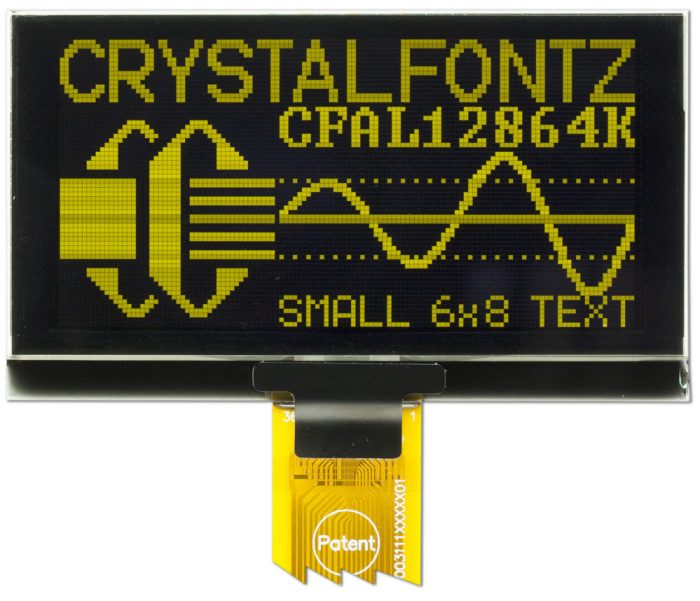
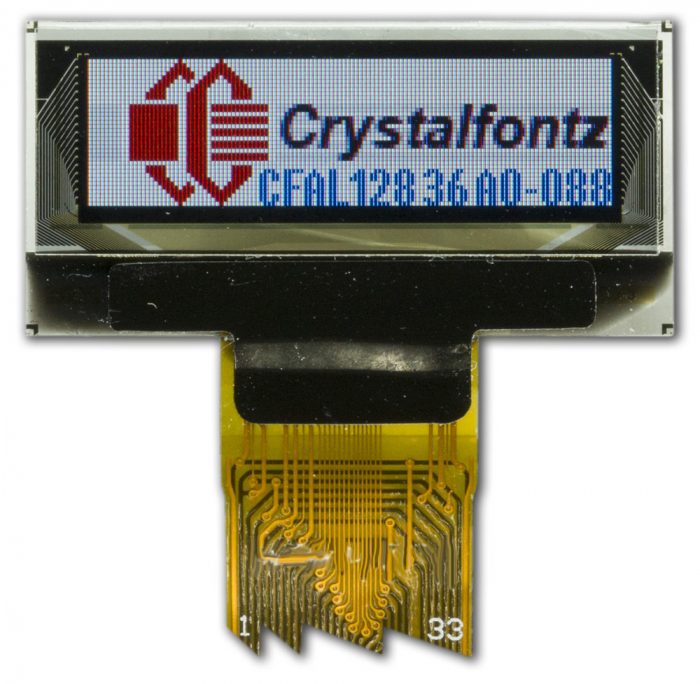
- Compact Designs: Small displays, such as the CFAL12836A0-088, can be less than 1.3mm thick.
- Standard Modules: Even larger displays like the CFAL12864K-Y typically stay under 2.5mm. This allows for sleeker handheld devices and more room for batteries or other internal components.
2) Infinite Contrast Ratios
OLEDs deliver “true blacks.” In a traditional LCD, the backlight is always on, often bleeding through dark pixels and resulting in a dark gray. In an OLED, a black pixel is simply off. This creates a sharp, eye-catching contrast that makes text pop and graphics look vibrant, which is critical for high-end UI/UX.
3) Near-Perfect Viewing Angles
Have you ever looked at a screen from the side and seen the colors distort or wash out? OLEDs eliminate this issue. These small but mighty displays offer a viewing angle approaching 180°, ensuring that the data remains legible even when the user isn’t looking at the device head-on.
4) Emissive Efficiency
OLEDs are emissive displays, meaning they generate their own light. This removes the need for a separate backlight, reducing the overall component count and simplifying the mechanical design of your enclosure.
5) Intelligent Power Management
One of the most valuable features for battery-operated devices is scaled power consumption.
Energy Savings: By designing a “dark mode” or a sparse user interface with minimal lit pixels, you can significantly extend the field life of your product.
Pixel-Level Control: Power usage is directly proportional to the number of pixels illuminated.
Is an OLED Right for Your Project?
Beyond the specs, OLEDs offer a level of “daylight readability” and response speed (often measured in microseconds) that traditional displays struggle to match. They are ideal for medical devices, industrial handhelds, and premium consumer wearables where performance cannot be compromised.
Questions about integrating OLEDs?
If you have any questions about OLEDs or what type of display module would work best for your project, please contact our knowledgeable and friendly support staff by email, phone, or chat.