
transmissive
Transmissive describes an LCD that depends entirely on a backlight behind the panel to be visible. Light comes from the backlight, passes through the rear polarizer, the liquid crystal layer, and the front polarizer, and reaches the viewer. The liquid crystal acts as a shutter that blocks or passes that light at each pixel.
The rear polarizer in a transmissive display has no reflective layer, so ambient light coming from the front isn’t bounced back to the viewer. With the backlight off, the display is essentially unreadable.
Strengths:
Best contrast and color saturation of the three main types, particularly indoors and in low light
Fully readable in the dark
Good fit for color TFTs and negative-mode displays (light characters on a dark background)
Weaknesses:
The backlight must be on whenever the display is in use, which makes it the highest-power option
Can wash out in direct sunlight, since the backlight has to compete with the ambient light (high-brightness backlights help, at the cost of more power and heat)
How it compares to the other two types:
Reflective: No backlight. A reflector behind the rear polarizer bounces ambient light back through the panel. Very low power and excellent in sunlight, but unreadable in the dark. Common on meters, calculators, and battery-powered devices.
Transflective: A partially reflective rear layer lets the display use both ambient light and a backlight. It’s readable in sunlight, can run with the backlight off in bright conditions, and works in the dark with the backlight on. The cost is somewhat lower performance in each mode than a dedicated transmissive or reflective display.
In practice, transmissive is the default for most TFT and indoor applications. Transflective or reflective panels are the better choice when sunlight readability or very low power matters, such as outdoor equipment or handheld instruments.
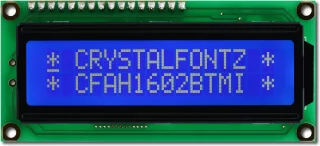
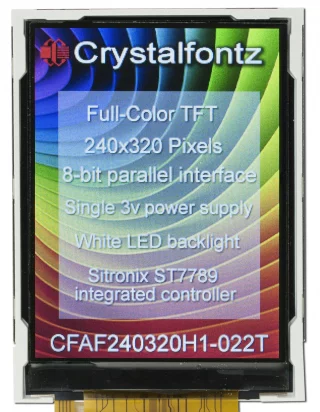
Transmissive LCDs can be seen easily in normal office lighting, and in darkness. Typically transmissive LCDs will not be visible in bright sunlight. It is possible to make a sunlight readable transmissive LCD by using a very bright backlight.
Transmissive LCDs are typically not used in systems where power consumption is critical since the display cannot be seen if the backlight is off. TFT LCDs as used in cell phones, tablets and TVs are transmissive and backlit.
View Crystalfontz Transmissive LCD Modules
Related Terminology
- Transflective LCD and Reflective LCD